
AI Shopping Assistant vs Traditional Search: Which Helps You Find Cheap Products Faster?
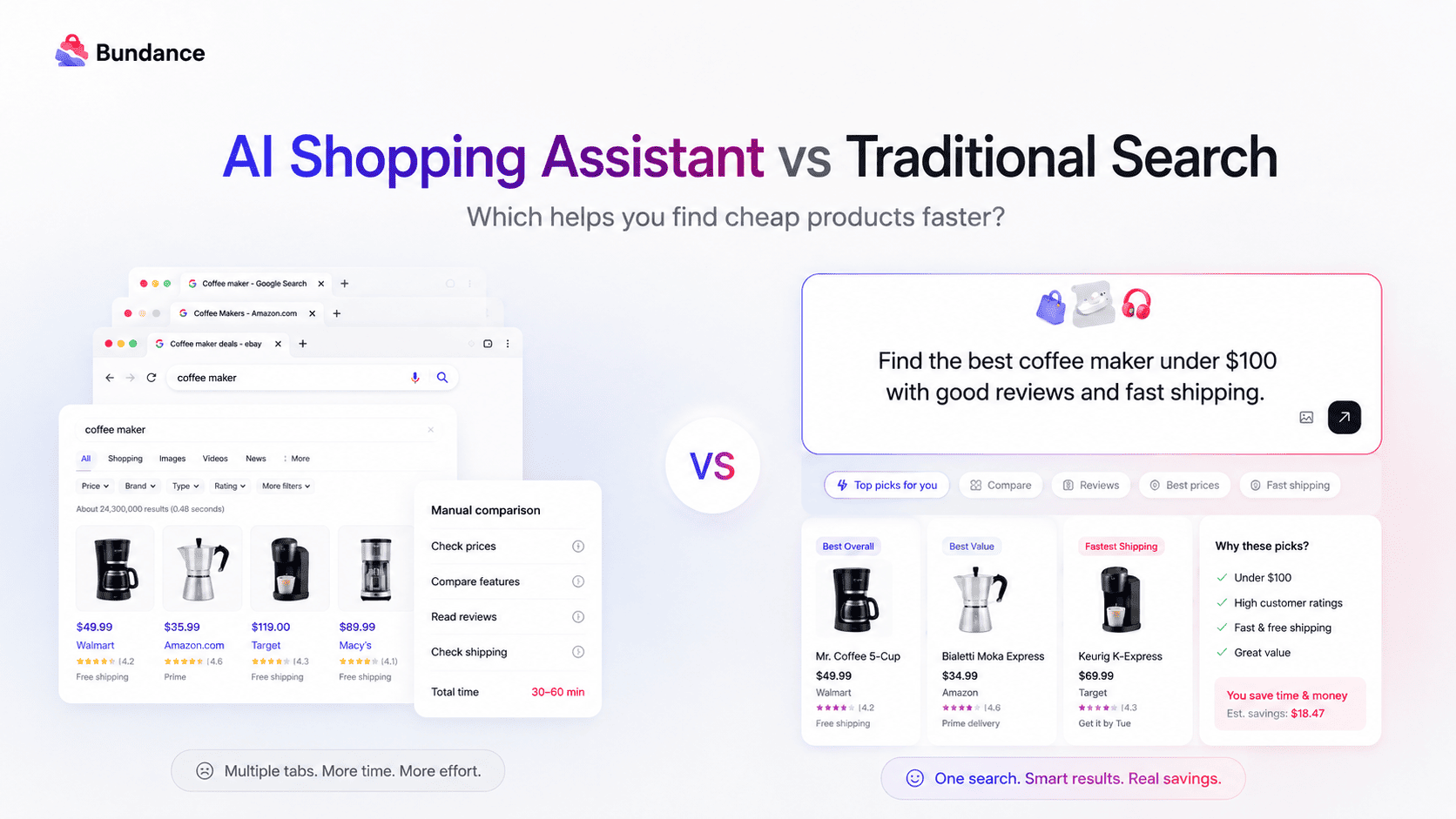
Finding a good deal online should be simple. But most of the time, it isn’t.
You search for “best budget coffee maker,” open ten tabs, compare Amazon with Walmart, check Target, read reviews, wonder if the cheaper one is actually worse, then somehow end up looking at products you never planned to buy.
That’s the problem AI shopping tools are trying to fix.
Instead of making you do all the digging yourself, an AI shopping assistant helps narrow the search, compare buying options, and suggest products based on what you actually need. Traditional search still has its place, but when you’re trying to shop smart and find cheap products without wasting an hour, AI can make a real difference.
One tool built around this idea is Bundance, an AI shopping discovery platform that helps shoppers compare products and find better buying options across retailers.
What Traditional Shopping Search Does Well
Traditional search is familiar. You type something into Google, Amazon, Walmart, or another shopping site, then scan the results.
It works well when you already know what you want.
For example:
- “Apple AirPods Pro 2”
- “Dyson V8 cordless vacuum”
- “Nike running shoes size 10”
- “Lodge cast iron skillet 12 inch”
If you’re shopping for a specific brand, model, or size, traditional search is usually fast. You can compare prices, check shipping, and buy from a store you already trust.
It’s also useful when you want direct access to reviews. Amazon reviews, Reddit threads, YouTube comparisons, and store ratings can all help you understand whether a product is worth buying.
The downside is that traditional search puts most of the work on you. You have to know the right words to search, compare similar products manually, and figure out which listings are actually good deals.
Where Traditional Search Gets Frustrating
Traditional shopping gets messy when your search is vague.
Let’s say you need:
- A cheap wedding gift under $50
- A good baby shower gift that doesn’t feel generic
- A small desk lamp for a dark apartment
- A budget blender that can handle smoothies
- A housewarming gift that looks nice but isn’t expensive
These are normal shopping problems, but they’re not always easy to search.
If you type “cheap wedding gift” into a search engine, you’ll get articles, ads, sponsored products, marketplace listings, and maybe a few useful ideas buried in between. If you search inside one store, you only see that store’s products.
That’s where AI and shopping start to make sense together.
What an AI Shopping Assistant Does Differently
An AI shopping assistant lets you describe what you’re looking for in plain language.
Instead of searching like this:
“coffee maker cheap good reviews small kitchen”
You can search like this:
“I need a compact coffee maker under $80 for a small apartment, preferably easy to clean.”
That gives the tool more context. A good shopping AI can understand the budget, the use case, and the tradeoffs. It can then help you compare options instead of just throwing a long product list at you.
This is the main benefit of AI for shopping: it helps translate your real buying need into better product discovery.
For example, Bundance works well as a starting point when you don’t know exactly what to buy yet. You can search naturally, compare products, and use the AI shopping assistant to narrow down options before checking the final retailer page. It’s not trying to make the decision for you. It just helps you get to a stronger shortlist faster.
AI Shopping vs Traditional Search
Here’s the simple comparison.
Traditional search is better when:
- You already know the exact product
- You want to buy from one specific store
- You want to read lots of reviews yourself
- You’re researching a major purchase in depth
AI shopping is better when:
- You have a budget but no specific product in mind
- You want gift ideas
- You want to compare different types of products
- You’re trying to find cheap options without sorting through endless tabs
- You want suggestions based on lifestyle, use case, or preferences
Think of traditional search as a map. Think of an AI personal shopper as someone helping you decide which places on the map are worth checking first.
Practical Example: Buying a Cheap Housewarming Gift
Traditional search:
You type “cheap housewarming gifts” and get candles, cutting boards, mugs, decor, and dozens of listicles. Some products are nice, some are overpriced, and some feel too generic.
AI shopping search:
You ask, “What’s a good housewarming gift under $40 for a friend who likes cooking and neutral home decor?”
That’s a much better starting point. An AI shopping app can suggest things like olive oil dispensers, spice racks, linen kitchen towels, small serving boards, or compact herb growing kits. Then you can compare prices and choose what fits.
This is the kind of search where a tool like Bundance is useful. Instead of starting with a blank search bar and guessing the right keywords, you can describe the person, budget, and occasion, then browse more relevant buying options.
The difference isn’t magic. It’s context.
Practical Example: Finding Cheap Everyday Products
AI in shopping can also help with less exciting purchases.
Say you need a new office chair, but you don’t want to spend $300. Traditional search might show you hundreds of chairs, many with similar photos and inflated ratings.
A better AI shopping query would be:
“Find a comfortable office chair under $150 for working from home, with good back support and no fake leather.”
That kind of request gives the assistant real filters to work with. It can help separate “cheap” from “cheap but probably annoying to use.”
That matters because the lowest price isn’t always the best deal. A $40 product you replace in two months isn’t cheaper than an $80 product that lasts.
The Limits of AI Shopping
AI shopping assistants are useful, but they’re not perfect.
Product prices can change quickly. Availability may differ by location. Some recommendations may miss details that matter to you, like return windows, warranty terms, material quality, or whether reviews are trustworthy.
You should still check the final product page before buying. Look at:
- Current price
- Shipping cost
- Return policy
- Recent reviews
- Seller reputation
- Product dimensions
- Warranty or support details
For expensive items, traditional research is still worth doing. If you’re buying a laptop, mattress, appliance, or high-end camera, don’t rely only on AI. Use it to build your shortlist, then check expert reviews and user feedback.
So, Should You Use AI for Shopping?
Yes, especially when you’re starting from a broad idea.
AI shopping works best when you need help narrowing choices, comparing options, or finding cheap products that still make sense. It’s especially useful for gifts, home goods, everyday items, budget buys, and “I don’t know what to get” situations.
Traditional search is still better when you know the exact product or want to inspect every detail yourself.
The smartest approach is to use both. Start with an AI shopping assistant like Bundance to get better ideas faster. Then use traditional search and retailer pages to verify the final details.
That way, you spend less time digging and more time choosing something worth buying.